Tuesday, February 10, 2009

Life and Death and Department Stores...Oh My.

Where I work, we often get some....shall we say...interesting... items to sell. While I stood there at the fitting rooms for what seemed like hours....well, it probably was hours, watching people come in and out with armfuls of prospective purchases, I started to think about the English homework I should be doing. I started thinking about some of the concepts brought up in Sexson's lectures and talking about some of them with some of my coworkers. "All that is past possesses our present." We're probably going to be incredibly tired of hearing that after a while, but nevertheless the words keep ringing in my ears. Everywhere I go, I'm confronted by myth. The characters of the ancient tales pervade every aspect of our existence, whether we know it or not.

On the last truck, we got a lot of these tanktops. And all of a sudden, there he was, the smiling face of Cupid, mischievous bringer of love... and all the drama associated with it. I couldn't believe the incredible timing of it all (though I suspect the proximity of Valentine's Day had something to do with it...) =)


Shrugging this off, I turned back to my work and the steady stream of people coming in and out of the fitting rooms. And then I saw a piece of clothing so disturbing... I had no idea what would entice someone to buy it. Here, right before my very eyes was a bright pink barely-there lingerie top with soft pink hearts all over it....and massive skulls playfully dancing over it all. It even came with a matching thong for Christ's sake. I thought to myself, what is the point of it all? Why would anyone want to buy lingerie on which the face of death stares back at you?...or rather...at your boyfriend... Well, someone wanted that effect I suppose, because when I went back to get a photograph for this blog, they were all gone. That's right. We sold out. And then I realized. That piece was just the beginning. Like the warning on a bottle of deadly poison, skulls were everywhere:
on girly yellow bras with pretty pink hearts....

and on fuzzy pink sleeping shorts.....

And then I realized. What if these countless skulls really are warnings? What if they are but premonitions of the dangers held within that most dramatic of relationships, between men and women.... like the idea of the individual's death in marriage or our bodies' eventual marriage with death. Antigone characterizes death as "my tomb, my marriage, my hollow, scraped in dirt, I'm coming home forever". Home. What an odd word she uses. Even the impersonal Chorus says a few words about Antigone, "soon to gain the marriage bed where everyone must sleep".
Still, even with the wider ramifications of the symbols I was witnessing reverberating through my mind, the whole concept seemed all too disturbing. Why do we even think of associating so dark a concept as death with that spring of life, and that basis of love within all of us? Is it because we seek to diminish the power of something we fear most of all by juxtaposing its image with that of the single greatest attribute of our life on earth? Or is it as simple as a warning sign.... the label on a bottle of cyanide we just can't help drinking...down to the last drop.


Friday, February 6, 2009

Reincarnation. That's when you come back as a frog isn't it?

Throughout my years of study, I remain continually astounded by how little most people know or care to know about this concept. All sorts of theories come to light on the subject, most of which are founded from a lack of information. In our attempt to stay westernized and "sophisticated," we often ignore the cultures most unique from our own; we deem this concept of cyclical time as ludicrous. This lack of diversity is a disturbing, yet pervasive trend. In high school, I remember the classes about "cultural diversity" we were required to take. Native American History, etc. We read books about slavery. And about "Indians". Having passed the class, we were given a figurative stamp on our foreheads that said we were "educated" and "diverse". I hated these classes.

I found it an insult to my intelligence to assume that I would be happy with this sloppily fabricated version of a diversified world view. At the same time, it sickened me that world history was a semester long class, the same as American history. The world has been around for thousands of years. We have only been here around 2oo. Yet the combined history of the entire world has the same weight and value as our measely two hundred years? How can we have the arrogance to assume we know everything there ever was or will be? Where is our humility?

As I was entirely unsatisfied with the educational system's definition of diversity, I began reading on my own time. I read about the army coup in Burma against which a staunch advocate of democracy was fighting silently. Aung San Suu Kyi has been under house arrest for the majority of her life. Yet we learn nothing of this conflict. Even when thousands of monks march in peaceful protest, we know nothing.


I read first hand accounts of the war in Afghanistan. I read books written by the prisoners in Guantanamo. I read poetry from the East and the Mediterranean. I read stories of war and love, poetry from France, novels from Russia....I sought out the "classics" that were deemed less than relevant to our diversification in schools. There is such a wealth of information, of beauty in this world that we are not allowed to see! Is it any wonder our children grow up to think America is the center of the world? Is it any wonder we go overseas and expect these cultures to conform to our language and standards? We are not exposed to the immensity of life! How can we know better?

Understanding. We can teach our children to see themselves as individuals belonging to a World of information, of people, of culture. We can teach them to see themselves as citizens of this vast and wonderfully diverse planetary body rather than as citizens of a single nation or thought process. We can expose this next generation to every idea, every culture, every religion and great innovation, rather than confining them...condemning them...to a life of stunted and singularly "Westernized" perspectives of the world.


Western cultures see time and our lives on this earth as linear....progressing to a final stopping point from which there is no return. To our eventual dismay, this world view continues to remain incompatible to our observations of the world. We see the seasons come and go in cycles of death and rebirth. We see history repeat itself endlessly, and we find no explanation. We see ourselves developing in terms of cyclical stages of time, and we stand confounded by the phenomenon. Why? We have attempted to impose an unbending rule of the straight line onto the ephemeral diversity of nature, both in the earth and in ourselves.


When Sexson spoke the other day of the eternal return, I found his words on the subject both surprising and extremely engaging. He gave an example: Kayla may die but she will come back later in a different body, at a different time, and with different memories but she will still be Kayla. Finally! This is reincarnation. I was immensely greatful to see it so aptly explained in terms even a Westerner can understand. Reincarnation isn't the chance to come back as a frog...or a fruitfly. It's the chance of time, a chance to learn what needs to be learned in this life, this one chapter, and if need be return again to learn what is still needed. After one has developed to his utmost potential, to the very zenith of his capabilities, he frees himself from the turning wheel of life, the cycles of death and rebirth. His soul travels on to other dimensions of learning and growth. Reincarnation is the freedom from an end, the chance to be continually better than what we were.

I googled the word "reincarnation" just to see what would come up and I found this quote by Henry Ford. Here is an excerpt: "Time was no longer limited. I was no longer a slave to the hands of the clock". In a world of cycles and continued understanding, we have the time to read the eternities. We are the eternities.

Friday, January 30, 2009

The music... the legend.

On Wednesday, Prof. Sexson asked us to think about the greatest musical moment in "history". Well I thought about it. A lot. And there are simply too many to say for certain one moment outshines them all. Perhaps the first moment the first instrument was played for the first time is the greatest....for in that moment, all those to come is contained. What of Mozart? And Beethoven? Playing for their first concertos at six or seven. This is the stuff of myth! How about the jazz musicians in Harlem playing their smooth rhythmns before an ever increasing, astounded audience? And of course, we cannot forget the ever immortal Elvis Presley. But before Presley, there were others, like him, bravely setting out and making their music despite all the naysayers, against all the criticism. How about when Johnny Cash, musical superstar, finally married the love of his life, the also musical June Carter? So much myth is contained in their story to be sure. There are the Beatles who took the world by storm; they must be mentioned too. How can we choose a single moment to sum up the entire course of musical "history"?

And what of all the anonymous music makers around the world? Those sweaty jungle beats of the Serengeti, the hypnotic strum of an Indian sitar, the sweet, piercing melancholy of a Japanese trill... What of the lives behind the music we never hear? The young thug who finds music remakes him. The mother softly humming to her child. A new band's very first gig. How can we measure and equate all such mysteries in a single span of time?

We cannot. Or at least we shouldn't. For each experience, each singular moment in time, is part of a great and incomprehensible legend...or myth.

Wednesday, January 28, 2009

Death in Love.

"Love is what drives and sustains us!' I translate: we don't know what drives and sustains us, only that we are most miserably driven and, imperfectly, sustained. Love is how we call our ignorance of what whips us."

[. . .]

"I am not deceived. This new emotion is Her doing; the desire that possesses me is Her bewitchment. Lucidity passes from me; in a moment I'll cry 'Love!' bury myself in Her side, and be 'transfigured.' Which is to say, I die already; this fellow transported by passion is not I; I am he who abjures and rejects the night-sea journey! I....
"I am all love. 'Come!' She whispers, and I have no will."
-------------------------------------------------------------------------------------------------

After class today, I thought I'd do a little more research on Sexson's reference to "Night Sea Journey" by John Barth which I found in its entirety in what I think is a Japanese blog of some sort. Still, the story is in English. At first, I was a little skeptical as to the literary genius behind a story told from the perspective of a sperm, but I was proven wrong within the first few paragraphs. What an odd perspective to find myself listening to! I thought it an absurdity at the very least, yet...this is a very literate sperm who uses words like "beset", "abhorrent", and "tautological" and who theorizes over the goal and nature of his very existence. His nameless character becomes a synecdoche for mankind as a whole. He struggles "Onward, Upward", as he says, with only the vaguest notion as to his ultimat epurpose in the tormenting darkness which he finds himself. At the end of his tortured journey, he can only hope that he leaves a legacy, something we, ourselves, strive to achieve every day of our lives. The difference between his story and our own is that we supposedly end in death, the sperm ends in love. The very last line of the story itself is an esctatic, horrified, "Love! Love! Love!" which can only echo Kurtz's last words in Joseph Conrad's Heart of Darkness: "The horror, the horror."

This character fears love because it represents the ending of self. He knows not what he will be, if anything, after he becomes a part of something, someone, else....after he loses any concrete definition as he plunges into the unknown. He fears the death of himself as as separate entity. Could that be what is proposed in one aspect by the Homeric Hymn of Demeter? Persephone plunges into the Underworld, into death itself by her marriage to Aidoneus. Perhaps the fear we often associate with marriage is but the deathly fear of the extermination of our preconditioned, circumstantially bound definitions of who we are. After all, what are we...really...when we cease to be completely disconnected from another...when we become something more than our individual selves? Do we still exist? Or are we lost within that single living organism existing in two seperate entities?

Though the entire short story presents some interesting concepts, the lines quoted above struck me most of all. Ignoring for a moment the fact that they are written almost as poetry itself, the word choice compells further analysis. The sperm uses the word "bewitchment" to describe his driving need to be "in" love. He says he has already died, for he has lost all reason. "I am all love" he says. A simple whisper converts his most ardent analysis, his antagonistic convictions; all of it is lost, destroyed, in a single word. this power of the female race to compel and liquefy defies definition just as the mother-daughter connection remains a mystery or "mustes" to the entire male race. There is a power in that silent communication, in love as well, something that cannot be combated through physical or mental force, that is terrifying. Our greatest fears stem from a fear of the unknown, for we know not how to face something we cannot begin to comprehend rationally. How then do we arm ourselves for the battlefield? What defences are left to us when we know not what we face or when we'll face it? Without question, death is one inarguable truth of life... inescapable. Love is another. And we have no will to fight it.

"We like to wait until kids are a little older to talk to them about things like...condoms and ritualistic human sacrifice for harvest"

When Prof. Sexson mentioned "The Lottery" by Shirley Jackson in class today, a lightbulb went off right above my head......figuratively. =D I don't really watch South Park, but in one of the episodes I have seen, they parody this very short story! In the South Park episode, the entire world is making Britney Spears' life a living hell so that she'll kill herself and the farmers will have a good corn harvest. In the end, they have to kill her with their cameras. If you watch the full episode, the last scene is the most eerie...the townspeople turn to a running newscast of Miley Cyrus...their next victim. I couldn't believe how accurate their storyline was in relation to the original text! They even threw in a line about "little Davy", a character from the short story. Anyway, check out the story if you're interested and then watch this clip I found.

Monday, January 26, 2009


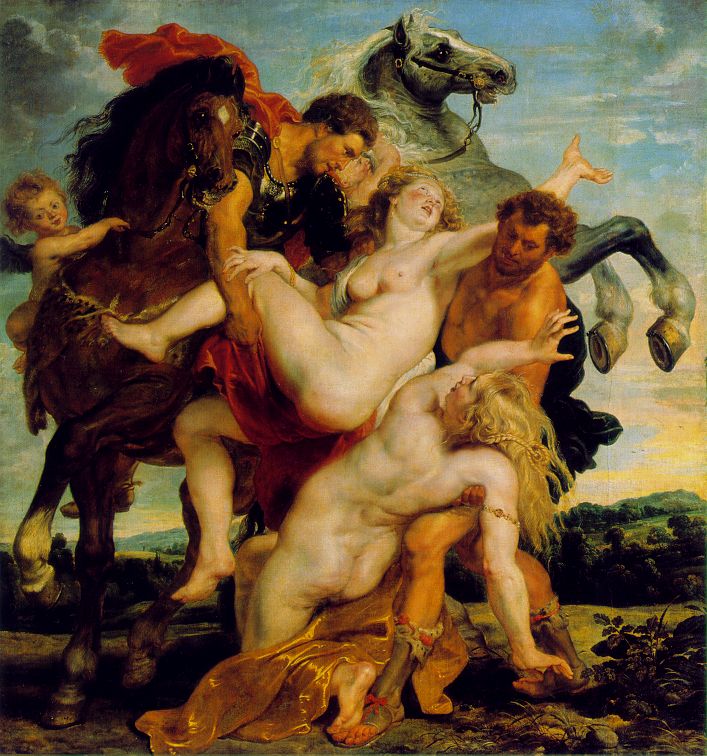
I thought I'd set up a few links to the myth Prof. Sexson related in class about the abduction of Helen of Troy by Theseus years before. When he mentioned Castor and Pollux, her brothers who come to her rescue, I couldn't help being overwhelmed by the sheer irony, the "an eye for an eye and the world goes blind" of it all. Theseus kidnaps Helen, Pirithous tries to kidnap Persephone, Heracles kidnaps Theseus from the underworld, Castor and Pollux kidnap their sister (from her abductor), and eventually Castor and Pollux kidnap the daughters of Leucippus for their own. The sheer irony of it all is just downright ridiculous. (The above painting is The Rape of the Daughters Leucippus by Rubens).


All that is past...(you know the rest)

Today in class, Prof. Sexson related the story of Zeus and Semele to the class. After reading Shoni's blog on the topic, I remembered this song by Russell Crowe that follows the same major themes. The most recurrent line is quite fitting to the story of Zeus and Semele: "Are you ready to take the weight of a man?" Semele was not, and it begs the question "why?" Why do we only want to deal with a diminished, restricted version of who a person is rather than the fullness of passion and fear, virtue and vice that make us human? Why can we not "handle the truth"?